Description
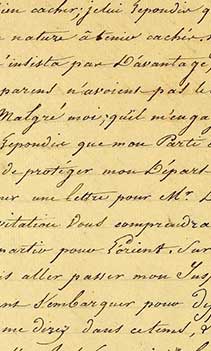
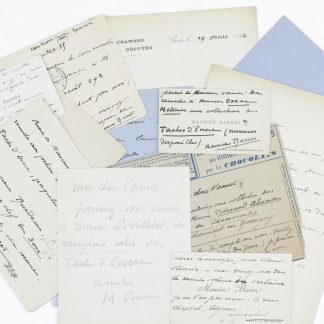
Friendly autograph letter signed to Max-Pol Fouchet concerning the review Fountain and "Le Météore du 13 août". This famous poem was to appear in issue 64 of Fountainwhich never saw the light of day; it was first published in 1947 in Cahiers d'art.
"Wednesday evening
Dear Max-Pol
I wasn't able to touch you earlier because I was called away to the south of France* [*vibrant paging], from where I have just returned. Yvonne Zervos is looking into your case. She saw Dias, who is due to meet the South American I told you about. We're expecting him any minute. As soon as I get a reply, I'll pass it on to you.
I've got horse flu and a nose that looks like a mouthpiece. But I'm back on my feet and no longer contagious, so I'll see you. See you soon.
Be kindIf you still have time, please send me a proof of the "Météore du 13 août". Very important small correction to be made. Return immediately.
Can I have 2 "Fontaine" 63 and 1 "Fontaine" 62. Have not been served.
Finally, dear Max, you have my paternal and affectionate thoughts.
René Char
6 rue Victorien Sardou. 16th arrondissementdate and place of birth for Picon :
14 July 1807 - L'Isle-sur-sorgue. Vse."
René Char joined the Resistance in 1942 under the name of "Capitaine Alexandre". Revolted by the censorship of Vichy and Berlin, he vowed not to publish his poems in occupied France. Nevertheless, from 1944 he contributed to the review Fountain led by Max-Pol Fouchet, based in Algiers and resolutely hostile to the Vichy regime. Char remained loyal to Fountain when, after the Liberation, the magazine moved to Paris, and contributed to 5 of its issues, not only as a poet but also as a columnist. Fountain published, among other things, the first extracts from Hypnos Leaves (1945) and The pulverised poem (1947).
Max-Pol Fouchet, with whom Char kept up an extensive correspondence, described him as "a great poet, a master of dignity, freedom and rectitude, a master whose morals married his poetry and whose poetry married his morals" (Jacques Chirac, "René Char"), La revue des deux mondesJuly 1989, p. 17)