Description
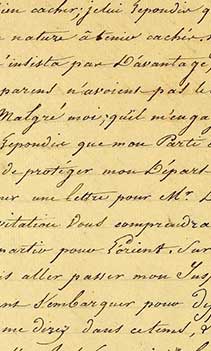
Autograph letter signed to Max-Pol Fouchet.
"3 rue de Montalembert - Monday
My dear Max-Pol,
I hope you're feeling better now. The same goes for me, where my "circulation problems" are turning me into a slightly anxious lookout!
See you on Saturday 12th, at Les Canettes at 12.45pm. Good to see you again.Fraternally
René Char."
René Char joined the Resistance in 1942 under the name of "Capitaine Alexandre". Revolted by the censorship of Vichy and Berlin, he vowed not to publish his poems in occupied France. Nevertheless, from 1944 he contributed to the review Fountain led by Max-Pol Fouchet, based in Algiers and resolutely hostile to the Vichy regime. Char remained loyal to Fountain when, after the Liberation, the magazine moved to Paris, and contributed to 5 of its issues, not only as a poet but also as a columnist. Fountain published, among other things, the first extracts from Hypnos Leaves (1945) and The pulverised poem (1947).
Max-Pol Fouchet, with whom Char kept up an extensive correspondence, described him as "a great poet, a master of dignity, freedom and rectitude, a master whose morals married his poetry and whose poetry married his morals" (Jacques Chirac, "René Char"), La revue des deux mondes(Jacques Chirac, "René Char", July 1989, p. 17), whose morality marries poetry and poetry marries morality", La revue des deux mondesJuly 1989, p. 17)
[1] f. recto handwritten in blue ink.